Menstrual Records
Menstrual Calendar: What should I track besides the start date to help with treatment?
By observing changes in bleeding, pain, and daily life over the last 3 cycles using the same criteria, we can specifically determine what to treat first among recurring menstrual pain and heavy bleeding.
Tracking your period is not a homework assignment to fill in blanks. You should record the sequence in which bleeding and pain begin, the discomfort that remains after taking painkillers, and the recovery after menstruation ends to clarify the direction of tests and Korean medicine treatment.
Before the start date, we look at how this period differed from your usual ones.
The start and end dates of menstruation are basic checks. Additionally, we look at how much earlier or later it was than the expected date, and whether full menstruation began after several days of brown spotting, intermenstrual bleedingor whether there was bleeding after sexual intercourse; this helps reveal changes in the cycle.
We check whether similar changes occur consecutively rather than a single fluctuation. Menstrual intervalIf two changes overlap, such as the cycle shortening while the amount of bleeding increases, or the cycle remaining the same but pain starting before menstruation, the causes to be checked first and the order of treatment during the medical evaluation will change.
Compare the amount of bleeding through changes in your daily life rather than just numbers.
It is difficult to accurately measure the amount of bleeding solely by the number of pads or tampons used. We can better understand the actual burden by looking at whether you had to change them much more frequently than usual, whether they were soaked every hour for several consecutive hours, whether you woke up due to leaking during the night, or whether large blood clots occurred repeatedly.
If shortness of breath, dizziness, throbbing, or lethargy persist after an increase in bleeding, it is not just a problem limited to the menstrual period. Through a blood test, Anemiait may be necessary to check the status, and in Korean medicine treatment, the plan must be designed to both reduce bleeding and help recover Qi and blood after menstruation.
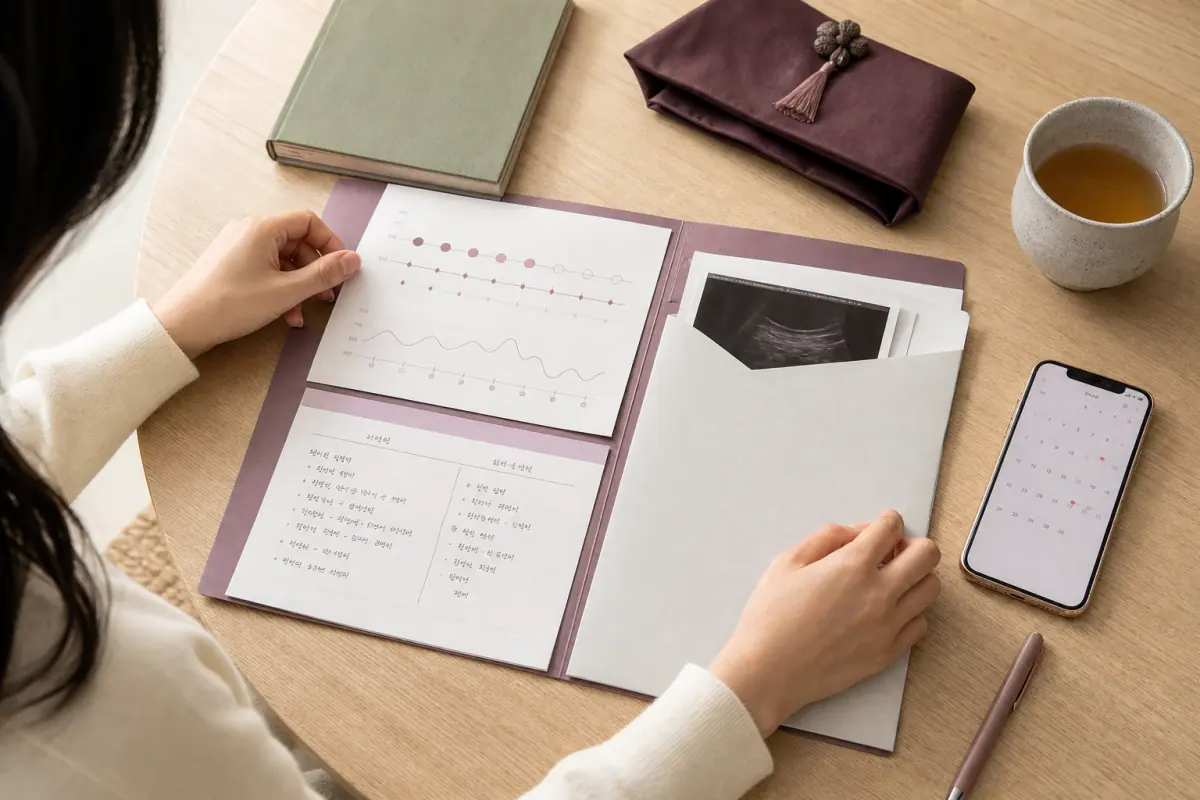
Organizing test results and treatment history chronologically helps you identify specific questions to ask during your next appointment.
For pain, the pattern of how it starts and ends is more important than the highest pain score.
We distinguish whether pain lasts for a few hours on the first day and then subsides, whether the lower back and pelvis feel heavy before menstruation, or whether bowel pain or pelvic pain remains after menstruation ends. Not only how much the pain decreased after taking painkillers, but also whether it returns immediately once the medication wears off and whether the frequency of dosage increases every month, helps in determining the treatment.
Please also observe if symptoms like a feeling of blockage in the solar plexus, constipation, or cravings for sweets occur before the pain, or if dizziness and fatigue linger for several days after a cycle with heavy bleeding. Even for the same Menstrual crampssymptoms, Baekrokdam looks at what fluctuated first to decide whether to first resolve the stagnation before menstruation or further reinforce recovery after bleeding, which changes the questions for the next prescription.
The scope of treatment includes the speed at which you return to your daily routine after menstruation ends.
Days when you had to skip work or class, nights when you woke up due to pain, or instances where you could not eat or had to stop exercising are not simple daily notes. They show the actual extent to which menstrual pain and bleeding disrupt your life, and they serve as information that determines the depth of treatment needed, even if the pain scores are similar.
Some people find that while pain decreases after menstruation ends, fatigue, dizziness, and poor digestion linger for more than three days. In such cases, rather than just lowering the pain during menstruation, the goal of Korean herbal medicine treatment includes the recovery after bleeding and the time it takes for sleep and digestion to return to normal.
Good records show what needs to be adjusted in the next prescription.
You do not need to fill out every item every day. Even if you only record the start date of bleeding, the hardest day, the response to painkillers, and the recovery days after menstruation in the same way, you can sufficiently see the difference between last month and this month. If taking notes is burdensome, you may simply mention three memorable instances during your medical evaluation.
After Korean medicine treatment, we observe whether the onset of pain has been delayed, whether bleeding disrupts your life less, whether the need for painkillers and rest has decreased, and whether your energy returns more quickly after menstruation. We use the menstrual calendar to maintain the aspects that have improved first and shift the focus of the prescription to the remaining discomforts.
The purpose of menstrual records is not to fill in as many items as possible. It is to compare the sequence of bleeding and pain, the disruption of digestion and sleep that occurred before the pain, the discomfort remaining even after taking medication, and the recovery after menstruation to determine what to maintain and what to change in the next Korean herbal medicine prescription.
Evidence and Update Information
This content was organized by Korean medicine doctor Choi Yeon-seung based on the materials below and was updated on 2026-09-01.
- ACOG: Heavy Menstrual Bleeding
- NICE NG88
- ACOG: Abnormal Uterine BleedingTiming, amount, cycle, and evaluation criteria for abnormal bleeding
- ACOG: Amenorrhea: Absence of PeriodsDefinition of amenorrhea and evaluation of pregnancy, endocrine, and structural causes
- ACOG: DysmenorrheaPrimary and secondary dysmenorrhea and medical evaluation criteria
- NICE NG88: Heavy menstrual bleedingEvaluation of menorrhagia and treatment selection recommendations