Bleeding Safety
When Menstrual Flow Increases: How to Categorize the Causes and Treatment of Heavy Bleeding?
When heavy bleeding occurs repeatedly, you should not simply endure the volume but identify the cause. Baekrokdam treats bleeding, pain, and the recovery of energy after menstruation as a single integrated process.
Heavy bleeding is not just about the number of menstrual products used. The extent to which bleeding disrupts your life, Anemiaas well as pain and causes such as uterine fibroids or adenomyosis, must be viewed together to see the necessary tests and the role of Korean medicine treatment.
To understand what 'heavy flow' means, we must first look at how it disrupts your daily life
If pads or tampons are soaked every hour for several consecutive hours, if you must change them during the night, or if large blood clots recur, it is difficult to dismiss this as simply a slightly heavy period. Cases where bleeding lasts more than a week or where you reduce outings for fear of soaking your clothes and bedding are also signs of excessive bleeding that requires treatment.
If there has been a sudden change compared to your usual pattern, the cause must be re-evaluated. Even for those who have always had a heavy flow, if recently Menstrual intervalthe interval has shortened or clots and pain have increased, we look at the overall trend of changes in cycle, pain, and loss of daily function, rather than just a single number for bleeding volume.
Dizziness and shortness of breath following bleeding can persist even after menstruation ends
Repeated heavy bleeding can lead to iron-deficiency anemia, causing shortness of breath when climbing stairs, heart palpitations, and difficulty waking up in the morning. If poor concentration, headaches, or lethargy remain even after your period has ended, it is advisable to check the severity of anemia through a blood test.
Do not delay medical evaluation if you feel as though you might faint, have difficulty breathing, or experience severe palpitations. After addressing the urgent condition, the treatment goal should be the speed at which sleep, appetite, and energy return along with the reduction of bleeding, so that the next period is less taxing.
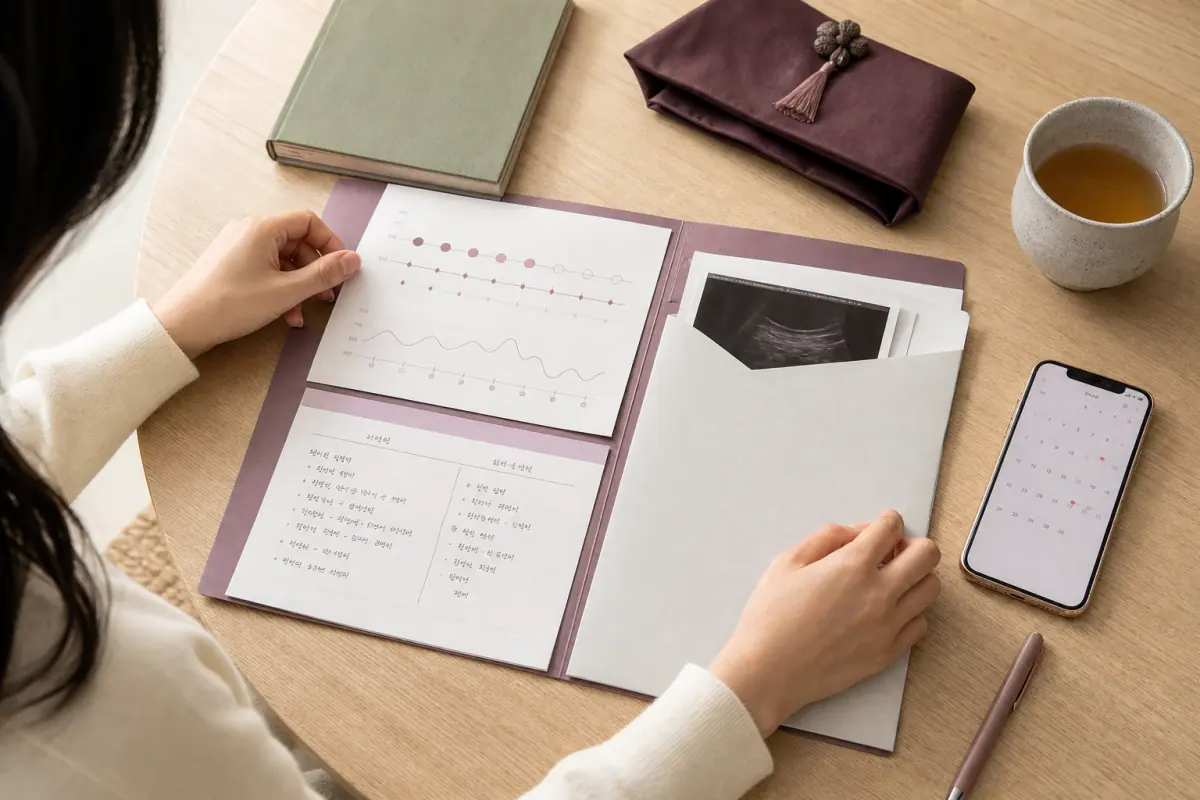
Organizing test results and treatment history chronologically helps you identify specific questions to ask during your next appointment.
Fibroids, adenomyosis, and ovulation issues each present different patterns of bleeding
For uterine fibroids, not only the size but also the location that transforms the inner uterus can significantly impact bleeding; for uterine adenomyosis, severe Menstrual crampsand heavy pelvic pressure often overlap with excessive bleeding. If ovulation is irregular, heavy bleeding may occur all at once after skipping periods for a long time.
Intermenstrual bleeding, post-coital bleeding, and new bleeding after menopause are Menorrhagianot grouped as the same problem. It is necessary to check for pregnancy possibilities, medications being taken, and the results of uterine and ovarian exams; the choice between observation, medication, procedures, or surgery varies depending on the cause.
Korean medicine treatment categorizes patterns where bleeding, pain, and poor recovery overlap
The treatment plan for the cause confirmed by tests continues as is. Along with that, we determine the direction of the Korean herbal medicine prescription by looking at the actual combination of symptoms, such as blood stasis patterns with many clots and stabbing pain, cases where cold and squeezing pain are prominent, or cases where the face is pale and energy remains low for a long time after bleeding.
During active bleeding, we do not unconditionally push for strong circulation. We prioritize among stopping bleeding, pain control, and restoring Qi and blood after menstruation, reflecting the timing and volume of bleeding, the degree of anemia, and pregnancy plans. Acupuncture is applied together when there is significant tension and pain in the lower back and pelvis.
Changes in treatment progress are confirmed during the next period and in subsequent daily life
Improvement is not limited to simply reducing the number of pads. Actual life changes when nighttime changes decrease, you no longer give up on schedules due to large clots and pain, and dizziness and fatigue recover quickly after the period ends.
Baekrokdam adjusts prescriptions by observing whether the bleeding has first become manageable, whether pain and pelvic pressure remain, and whether energy has recovered by the next cycle. While not overlooking the tracking of structural causes and anemia treatment, we clearly define the scope of recovery that Korean herbal medicine treatment will handle.
For example, if pain has decreased but energy, appetite, and sleep take a long time to return after menstruation, the next treatment goal is shifted toward reinforcing recovery; if dizziness has lessened but pelvic heaviness and large clots remain, the goal is shifted toward focusing more on the bleeding and pressure axis.
Excessive bleeding is not just about reducing the volume. Our goal is to identify the cause while simultaneously treating the bleeding, pelvic pain, and the loss of energy following anemia to reduce the extent to which menstruation disrupts your daily life.
Evidence and Update Information
This content was organized by Korean medicine doctor Choi Yeon-seung based on the materials below and was updated on 2026-09-01.
- ACOG: Heavy Menstrual Bleeding
- NICE NG88: Heavy menstrual bleedingEvaluation of menorrhagia and treatment selection recommendations
- ACOG: Abnormal Uterine BleedingTiming, amount, cycle, and evaluation criteria for abnormal bleeding
- ACOG: Amenorrhea: Absence of PeriodsDefinition of amenorrhea and evaluation of pregnancy, endocrine, and structural causes
- ACOG: DysmenorrheaPrimary and secondary dysmenorrhea and medical evaluation criteria
- ACOG: Chronic Pelvic PainCauses of chronic pelvic pain and functional impact assessment