Preparing for Pregnancy
How to Coordinate Infertility/IVF Treatment and Herbal Medicine within One Plan?
We first verify the tests and next procedure schedules for both partners, and coordinate herbal medicine treatment to address menstruation, sleep, digestion, pain, and recovery after egg retrieval according to the stage.
Infertility treatment is a continuous process of tests, procedure schedules, injections, medication, and bodily recovery. Rather than adding Korean herbal medicine as a separate plan, the current cycle stage and medication should be shared to accurately divide the roles and timing of each treatment.
Infertility cannot be explained by a single value from one person
Infertility evaluation ovulationis not a test that looks only at ovarian reserve. To prevent the overall treatment time from becoming unnecessarily long, the condition of the uterus and fallopian tubes, the duration of pregnancy attempts, history of miscarriage and surgery, and the male partner's medical history and semen analysis should be checked during the same period as much as possible.
Generally, evaluation begins when pregnancy has not occurred for 1 year for those under 35, and 6 months for those 35 and older, provided there are no special risk factors. amenorrhea·If there are risk factors such as irregular ovulation, endometriosis, or a history of ovarian surgery, we do not wait until this period is completed.
Test results only need to be visible at a glance enough to determine the next choice
AMH·When AFC, FSH, ovulation status, fallopian tube tests, uterine condition, and semen analysis results are listed with recent dates, any missing evaluations become apparent. The dosage of injections used in previous ovulation induction, the number of grown follicles, and the results of retrieval, fertilization, and embryos are also directly reflected in the next procedure plan.
The goal is not to organize documents perfectly. As long as it is clear which stage you are currently in, what will be done in the next cycle, and which point was the most physically taxing during the last procedure, we can specifically tailor when to start and pause herbal medicine treatment.
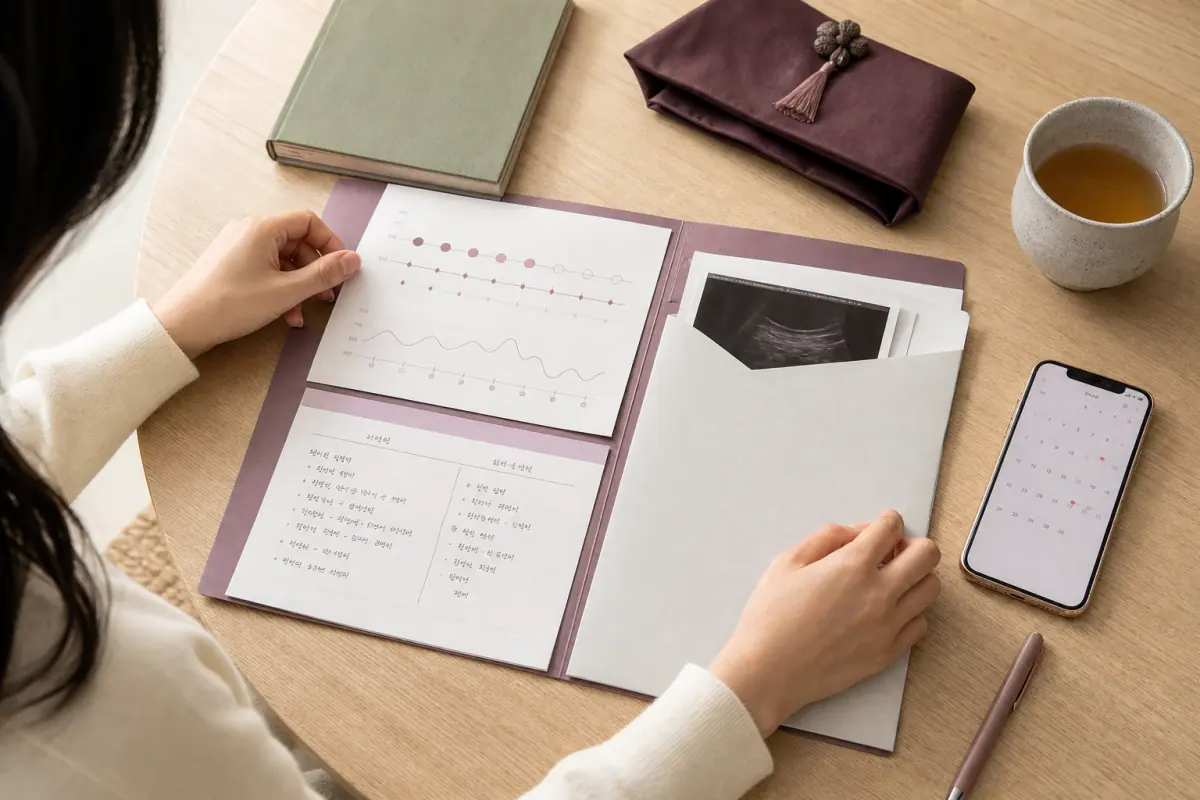
Organizing test results and treatment history chronologically helps you identify specific questions to ask during your next appointment.
Injections, vaginal suppositories, prescription medications, and herbal medicine are coordinated within a single schedule
Once the ovulation induction injections, follicle growth monitoring, and retrieval/transfer dates are set, we share the entire medication regimen, including prescription drugs, vaginal suppositories, injections, and supplements. You may provide photos of medications if you do not know their names. We determine the timing of intake according to the procedure stage without arbitrarily omitting medications or adding new herbal medicines.
The procedure protocol and the body's response can vary by cycle. Even if it was fine before, if abdominal bloating, constipation, insomnia are severe, or if eating is difficult this time, we do not continue the same herbal medicine but adjust the intensity and duration of the prescription.
Korean medicine treatments serve different roles before the procedure, during the injection period, and after egg retrieval
Before the procedure, we examine the menstrual cycle and Menstrual crampssleep, digestion, cold sensitivity, and fatigue to organize the body's rhythm before starting the next treatment. During the injection period, we prioritize the fertility center's plan while finely tailoring the prescription to reduce abdominal bloating, constipation, and tension that interferes with sleep.
After retrieval, we assist recovery by observing how long pelvic discomfort, loss of appetite, constipation, edema, and fatigue persist. During sensitive periods such as before and after transfer, the current prescription must be re-verified to determine the timing for maintenance, pausing treatment, or resumption.
The goal is not the number of procedures, but preparing the body to handle the next stage
If the changes in Korean medicine treatment are judged solely by the pregnancy result, you may miss the parts that actually improved during the treatment process. We check whether sleep and appetite are maintained during the injection period, whether you recover quickly from abdominal discomfort and fatigue after retrieval, and whether menstruation and energy are restored by the next cycle.
Baekrokdam manages the areas where patients struggle during the procedure process using herbal medicine and acupuncture while respecting the timing of professional medical treatment. If sleep has improved but digestion and pelvic discomfort remain, we shift the focus of the next prescription; if the procedure plan changes, the stage of Korean medicine treatment changes accordingly.
During a rest cycle, we recover from the fatigue, abdominal bloating, and menstrual changes remaining after previous stimulation and retrieval; if the next cycle begins immediately, we adjust the prescription to be lighter to fit the schedule. Even for the same patient, the role of herbal medicine continues to change depending on the treatment stage.
Infertility/IVF treatment and herbal medicine treatment do not operate separately. We first set the test and procedure schedules for both partners, and herbal medicine and acupuncture handle menstruation, sleep, digestion, pain, and recovery after retrieval according to the stage.
Evidence and Update Information
This content was compiled by Korean medicine doctor Choi Yeon-seung and updated on 2026-08-31.
- ASRM: Fertility Evaluation of Infertile WomenTiming of infertility evaluation and assessment of ovulation, fallopian tubes, uterus, and ovarian reserve
- ASRM: Ovarian ReservePrediction of ovarian stimulation response via AMH and AFC and limitations of interpretation
- ASRM: 2023 International PCOS GuidelinePCOS diagnosis, metabolic, and reproductive management recommendations
- ACOG: Abnormal Uterine BleedingTiming, amount, cycle, and evaluation criteria for abnormal bleeding
- ACOG: Amenorrhea: Absence of PeriodsDefinition of amenorrhea and evaluation of pregnancy, endocrine, and structural causes